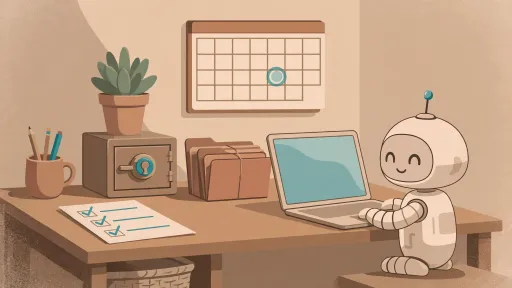
I have a rule for new AI tools: I try them on real work, not on a demo. So when I wanted to see what Nod could do, I handed it the most boring job I had, the scripts that keep this blog pipeline running, and I let it run them.
Nod is a standalone personal agent from n8n Labs. It is not n8n. It is open source under Apache 2.0, and it arrived as a research preview on November 10, 2026. It runs on your own computer, in a sandbox, with a model you bring yourself. It keeps logins and cards in a local vault, and it asks before it does anything the request did not cover, like sending, paying, posting, or deleting.
What we cover
- What Nod actually is
- The first test: a repo of scripts, no hand-holding
- What I am moving into it
- The rough edges
What Nod actually is
Think of it as a local agent with a browser and a computer of its own, plus manners. You give it a job, it works through the steps, and it stops to ask when something goes beyond what you asked for. That last part is the whole pitch for me. An agent that runs my scripts is useful. An agent that runs my scripts and asks before it posts anything is one I can trust with real work.
The vault matters too. Logins and cards stay on the machine, in a local vault, instead of living in someone else's cloud. For work content, that is a real difference, and it is why I see Nod as a promising alternative for work, not just a toy for weekends.
The first test: a repo of scripts, no hand-holding
On November 21, I gave Nod a repo of scripts and told it to run them. That is the whole test. No walkthrough, no babysitting. It ran them autonomously, and it kept going on a schedule, apparently without me. The experience felt familiar, because I use Muse daily, and Nod speaks the same language of plans, steps, and check-ins.
One test does not make a verdict. It makes a reason to keep going. The scripts ran, nothing broke, and nothing went out without my say-so. That is a pass for a first run.
What I am moving into it
The plan is to move my article pipeline into Nod. The draft run through the site API, the Sunday ideas session, the verification checks, all of it, with publishing staying mine. I wrote up the plan as a ticket, and the guards are the point: never publish, never create a coffee review node without my explicit per-post approval, never delete anything, and never patch a published node that has a working copy. If you want the full spec reach out.
Hosting is simple for now: it runs on a computer for the proof of concept, and it moves to a server after the proof of concept works. That is the honest order. A server is easy to justify once the work is proven. Before that, it is just a bill.
The rough edges
Two problems are already on the list. First, Nod stops when the laptop sleeps, so scheduled jobs need a machine that stays awake. Second, it is a research preview, and it shows. Rough edges are part of the deal at this stage, and I am treating them as things to work around, not reasons to quit.
Those are acceptable problems for a proof of concept. They would be unacceptable for the finished pipeline, which is why the server move waits until the POC proves out.
Final thoughts
Nod is the first local agent I have tried that feels built for real work instead of demos. It asks before it acts, it keeps secrets local, and it ran my scripts without me watching. I am going to keep pushing it through the pipeline and see where it bends.
The short version: Nod runs locally, asks before it acts, and passed its first real test. The pipeline move is next, with publishing staying mine.
If you want to poke at it yourself, the repo is n8n-io/nod on GitHub.