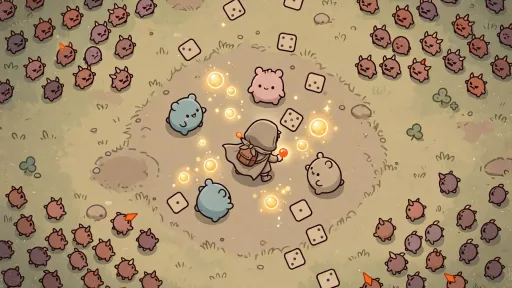
I am building a survivors-like game for kids, and it is called Number Swarm. You move, your character attacks on its own, enemies drop XP, and every level up offers you a draft of upgrades. The waves keep escalating. And between the waves, math questions gate the power-ups, so the game is a math game wearing a survival game's clothes.
This is the first devlog. It covers the concept, the decisions that are already locked, and the ones that are still open. The game is early, the beta is being built now, and this is the record of where it stands.
What we cover
- The core loop: move only, auto attacks, XP drops, level-up drafts
- Why it is web-first, and what that buys us
- How math fits in without breaking the game
- Original creatures only, and why that is a hard rule
- What is still undecided
The core loop
Number Swarm takes the survivors-like formula and strips it down to what a kid can pick up in a minute. You move. That is the only control. Your character attacks automatically. Enemies drop XP when they fall. Collect enough XP and you level up, which offers a draft of upgrades to choose from. The waves escalate as you go.
Move-only is a deliberate choice. A kid holding a phone with one hand should be able to play, and a game with one input is a game that is easy to learn and hard to get wrong. The depth comes from the drafts, not from the controls. Choosing between three upgrades, with the wave getting harder behind you, is where the decisions live.
Why web-first
The game is being built web-first, as a PWA, with a three to six week timeline for the first playable version. The web is the fastest way to get it in front of kids, and a PWA installs on a phone without an app store review cycle.
Web-first also means the game is playable everywhere on day one: a phone, a tablet, a laptop, a classroom Chromebook. For a kids game, that reach matters more than a store listing. The app store can come later, once the game is proven.
How math fits in
The math is the gate, not the game. Power-ups are locked behind questions, so answering correctly is how you get stronger. The questions are the price of the upgrade, and the upgrade is the reward for the answer.
That design is the whole bet. If the math feels like homework, the game fails. If the math feels like the way you earn the good stuff, the game works. The questions have to be quick, fair, and matched to the player, because a question that stops the game dead is a question that kills the fun.
This is the part my daughters will test hardest. They are the QA team for Math Buddies, and they will be the first players of Number Swarm too. If the questions feel like a chore to them, I will know before anyone else does.
Original creatures only
One hard rule: original creatures only. No Pokemon, no borrowed characters, no IP that is not ours. That is not a legal hedge. It is a design rule.
Original creatures mean the game has its own identity from the start. The swarm is ours, the upgrades are ours, and the art direction is ours. It also means we can do whatever we want with the characters later, because nobody else owns them.
How the beta is being built
The beta is being built by Freebuff, an AI coding agent, with placeholder art. I will add the real assets and the facelift after the beta proves the loop works. That order is deliberate: prove the game is fun with grey boxes, then make it beautiful. Art first would mean polishing a game that might not work.
The build is clean-room. It is not forked from BareTread or any other codebase. The game is its own thing, built from scratch, which keeps the architecture simple and the ownership clear.
I bought a domain for Number Swarm in October. The name is liked, the concept is set, and a search of the App Store found no app by that name, though that is not definitive. Reserving the name in App Store Connect is the real check, and that is still to come.
What is still undecided
Two things are open. First, standalone versus a Math Buddies mode. Number Swarm could be its own game, or it could live inside Math Buddies as a mode. A reskin with Benji and Duke, the star trail companions, has been floated for the Math Buddies version. Both paths are real, and the beta will help decide which one the game wants to be.
Second, the art direction. Placeholder art gets the beta built. The real look comes after, once I know what the game feels like to play. That is the fun part, and it is still ahead.
Final thoughts
Number Swarm is a small idea with a clear shape: move, collect, draft, survive, and answer math to get stronger. The next devlog will cover the beta, what worked, and what changed. For now, the concept is locked, the build is underway, and the kids are waiting to test it.
The short version: move only, auto attacks, XP drops, level-up drafts, and math questions that gate the good stuff. Original creatures, web-first, and a beta that proves the fun before the art arrives.