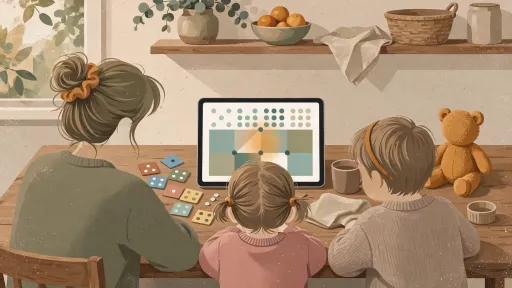
I build Math Buddies with my daughters. They are 8 and 11, and they are the app's QA team. Every week we sit down for a family build session, play what I have been working on, and decide together where the app goes next. They are the reason the app is shaped the way it is, and they catch things no adult tester ever would.
This is not a cute story I tell about the app. It is the actual process. The girls play the builds before anyone else does, they tell me what is boring, and I change the app based on what they say. If you have ever wondered why Math Buddies feels different from other math apps, this is why. It was tested by the people it is for, from the start.
What we cover
- How the weekly family build sessions work
- What kid testers catch that adults miss
- The design rules that came out of watching them play
- Why new concepts stay untimed
- What read-aloud everywhere actually means
How the weekly sessions work
Once a week we sit down and the girls play the latest build. I watch more than I talk. I want to see where they get stuck, where they laugh, where they get bored, and where they ask for help. Then we talk about it, and the next week of work comes out of that conversation.
The sessions decide direction, not just details. The girls have a real say in what gets built next, because they are the ones who have to want to open the app. An adult can guess what kids want. A kid will just tell you, usually in one sentence, and usually correctly.
The rule in the room is simple: if it is boring, say so. I would rather hear that in the living room than read it in a review.
What kid testers catch that adults miss
Adults test software by following the happy path. Kids test it by doing everything you did not expect. They tap things twice, they skip instructions, they try to break the rules, and they wander off the path you designed. That is exactly the testing a kids app needs, because that is how kids actually use it.
They also have no patience for friction. An adult will tolerate a confusing screen and figure it out. A kid will just leave. Every confusing moment in the app is a moment a kid stops playing, and my daughters find those moments fast.
The other thing they catch is tone. If a character sounds condescending, they notice. If a celebration feels fake, they notice. If a buddy is fun to dress up, they will spend twenty minutes on it and tell me exactly which outfits are the best. That is user research no survey will give you.
The design rules that came out of watching them play
Three rules in Math Buddies came directly from these sessions. First, new concepts stay untimed. When a kid is meeting a new idea for the first time, a timer does not make them faster. It makes them anxious, and anxiety is the opposite of learning. So the first time a concept appears, there is no clock.
Second, checkpoints stay on classic mode. Classic is the steady, familiar way to play, and a checkpoint should feel like solid ground, not a new challenge. The wild modes are for practice and fun. The checkpoint is where you show what you know, in the mode you already trust.
Third, read-aloud applies everywhere. Every mode, every screen, every instruction can be heard as well as read. Some of that is for younger kids who are still building reading fluency. Some of it is for kids who just learn better by hearing. Either way, it is not a feature bolted onto one mode. It is how the whole app works.
Why this works for Math Buddies specifically
Math Buddies is a big app now. Nine grades, ten game modes, over a thousand lessons, and eleven companions to collect and dress up. Benji and Duke, the star trail companions, are modeled after our pets at home. Gray, a silver tabby who spots a pattern in every trail, joined the crew this year.
An app that size is easy to get wrong in small ways. A mode that made sense on paper can feel flat when a kid plays it. A lesson sequence that looks right in a spreadsheet can drag in real life. The weekly sessions are how I catch that before it ships, instead of after.
The girls are not just finding bugs. They are shaping the product. When they ask for something, it goes on the list. When they say a mode is their favorite, I know where to put the next effort. That is a product process most indie apps never get, and I get it every week at my own kitchen table.
Final thoughts
If you are building something for kids, find real kids to test it, and listen to them more than you listen to adults. They will tell you the truth about your app in the time it takes an adult to write a test plan.
The short version: my daughters are the QA team, the weekly session is the roadmap meeting, and the app is better because the people it is for get a vote.